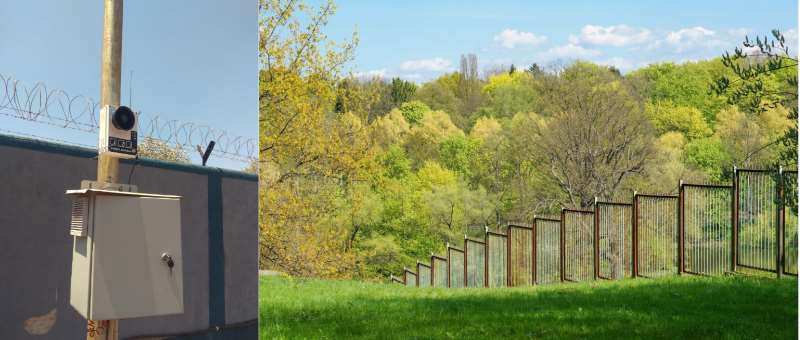
"When a guard is two kilometers away, every second matters. Long-range RF panic networks push the alert to control at once. Distance, terrain, and weather should not block that call."
Why Large Perimeters Are Hard
A warehouse yard may cover dozens of acres. A plant fence can run three kilometers end to end. Security teams then work far from the control desk.
Phones fail in dead zones. Radios need talk time under stress. Wired alarms rarely make sense across that distance. Consequently, sites need a dedicated RF panic path.
How Long-Range RF Networks Work
These systems use free ISM band RF around 380–480MHz. No special license is needed for typical industrial use. Error checks help signals survive noisy sites.
Each guard carries a compact panic transmitter. One press sends an encrypted RF alert to receivers. Meanwhile, repeaters can bridge the farthest corners.
RF Signal Coverage Visualization
Key Network Components
A solid network mixes a few part types. Match the mix to your fence length and post count.
| Component | Function | Range Coverage |
|---|---|---|
| Panic Button Transmitters | Portable emergency alert devices carried by security personnel | Up to 1km direct, 3km+ with repeaters |
| Central Receiver Units | Receive and process alarm signals from all transmitters | Network-wide coverage |
| Signal Repeaters | Extend range by relaying signals across large distances | Extends coverage by 2-3km per repeater |
| Alert Display Systems | Visual and audible alarms at control centers | Centralized monitoring |
| Siren Units | Loud audible alerts for facility-wide notification | Site-wide coverage |
What Affects Range
RF distance is real-world, not just brochure numbers. These factors matter most.
Signal Strength by Distance
Terrain: Open fields give the best reach. Buildings and hills can cut range by roughly 30–50%. Dense sites usually need more repeaters.
Antenna height: Roof or tower mounts help a lot. Higher receivers can extend coverage by about 40–60%.
Interference: ISM bands are shared. Good designs use hopping and checks to stay reliable. Nevertheless, always test on your actual ground.
Common Deployment Cases
Different sites need different layouts. Here are patterns we see often.
Industrial Warehouses
A 40-acre Delhi complex used 12 panic buttons and 3 receivers. Two repeaters covered the far docks and storage yards. Total span reached about 2.8 kilometers with solid tests.
Construction Sites
A 1.5 km multi-phase site needed movable coverage. Portable receivers shifted as buildings rose. Supervisors kept panic buttons without new cabling each phase.
Agricultural Operations
Farms may stretch several kilometers between sheds and fields. Repeaters and weather-ready housings keep the path open. Staff can call help from remote corners of the land.
We cover 3.2 kilometers of fence with RF panic alerts. Every guard can reach control instantly from any post. Response felt faster, and the team feels less alone.
Network Design Tips
Plan first, then mount hardware. These habits improve reliability.
-
Place Receivers High
Use roofs, towers, or other high points.
Height improves both range and consistency.
-
Plan Repeater Overlap
Past about 1.5 km, add overlapping repeater zones.
Overlap also covers a single unit outage.
-
Study the Terrain
Map hills, sheds, and thick tree lines.
Then place gear where signals can pass.
-
Build Redundancy
Do not depend on one receiver alone.
Security alerts need a backup path.
-
Test and Tune
Walk the fence and log weak spots.
Afterward, shift antennas or add one repeater.
Compared With Other Options
RF panic networks beat common alternatives on large land.
vs. Mobile Phones: RF works where cellular is weak. One button is faster than pulling out a phone under stress.
vs. Walkie-Talkies: Panic needs no voice exchange. Encrypted one-touch alerts are quieter and clearer.
vs. Wired Systems: You avoid kilometers of trench work. Layout changes stay simple as the site grows.
Linking to Existing Security Gear
Many RF receivers offer relay outputs for other systems. Those relays can start CCTV recording or lock a gate. FORBIX SEMICON® kits often support this style of hookup.
Typical integration options include:
- Relay outputs for alarms, lights, or gates
- Serial/network links for security software
- Event logging with timestamps for audits
- Multi-zone IDs so staff know where to go
- Escalation steps for automatic follow-up alerts
Maintenance and Reliability
These networks are built for all-day use. Transmitters often run 2–4 years on batteries. Receivers sit on AC power with optional backup.
A practical check list looks like this:
- Monthly visual checks of buttons and mounts
- Quarterly battery checks for transmitters
- Annual signal tests along the full perimeter
- Receiver software updates when the vendor issues them
Failures are uncommon when you keep that rhythm. If one unit fails, replace it without shutting the network.
What to Look For When Buying
Focus on range, uptime, and clear control-room alerts.
Range and Repeaters
Confirm base range around 3 km+ if you need it. Ask how many repeaters your fence shape requires. Particularly, irregular sites need a placement plan.
Battery Life and Testing
Prefer 2–4 year transmitter batteries. Monthly test mode should be simple for guards.
Central Display
Control staff must see device ID at once. Audible and visual alerts both matter at night.
Outdoor Durability
Choose weather-ready housings for rain and dust. IP65-class gear suits many outdoor posts.
Frequently Asked Questions
What is a long-range RF panic alarm network?
It is a wireless emergency alert system for large sites. Staff press panic buttons that reach central receivers by radio. No perimeter cabling is required.
What range can I expect?
Many systems offer about 3 km in open space. Repeaters extend coverage to outer fence lines. Terrain and buildings still change real results.
How much does a large perimeter network cost?
A 2 km example with 20 buttons, 3 receivers, and 2 repeaters often lands near ₹2.5–3.5 lakhs. That is commonly far below wired trench quotes.
What should I look for?
Look for strong range, repeater support, and long battery life. Also check encrypted links and a clear receiver display.
Can RF work in harsh sites?
Yes. License-free RF works outdoors and in industrial yards. For dust and rain, pick rugged or waterproof transmitters.
Cost Snapshot
For large perimeters, wireless usually wins on total spend. Savings of about 60–80% versus wired are common.
Compare ₹2.5–3.5 lakhs wireless with ₹8–12 lakhs wired. Wired quotes balloon with cable, trench, and long labour.
Planning Your Network
Start with a short site brief:
- Perimeter size: measure the full coverage path
- Terrain: note hills, sheds, and metal walls
- User count: decide how many panic buttons you need
- Control room: place receivers near monitoring staff
- Growth: leave room for extra posts later
Ask for a site survey when the land is uneven. FORBIX SEMICON® can help map receivers and repeaters.
To conclude, long-range RF panic networks fit big perimeter security. They give fast alerts across distance without cable trenches. For hectare-scale sites, that mix of range and cost is hard to beat.